Why Rainbow Mountain is striped
Vinicunca is not painted, not dyed, and not a trick of the camera. The colours are mineral, they go all the way through the rock, and they have been there for tens of millions of years — which raises the obvious question of why nobody was photographing them twenty years ago.
What you are actually looking at
The ridge is a stack of sedimentary layers — sandstones, mudstones and clays laid down one on top of another over roughly sixty million years, in a basin that was sometimes a riverbed, sometimes a shallow sea and sometimes a desert.
Each environment deposited different sediment carrying different metals. Then the whole stack was lifted and tilted by the growth of the Andes, and erosion cut a cross-section through it. What you see from the viewpoint is the edge of the layer cake.
The bands, colour by colour
| Colour | Mostly caused by | Deposited in |
|---|---|---|
| Red and pink | Iron oxide — haematite and clay | Oxygen-rich conditions; a dry, exposed environment |
| White | Quartz-rich sandstone | River sands |
| Yellow and ochre | Iron sulphide weathered to limonite | Shallow water with limited oxygen |
| Green and turquoise | Copper oxides and chlorite | Marine sediments rich in copper |
| Lavender and grey | Mudstone with mixed minerals | Quiet, muddy, low-energy water |
| Brown and maroon | Iron and magnesium rich clay | Later alluvial fans |
Simplified. The exact chemistry varies band to band, and the field literature is more careful about it than a tour page needs to be.
Why it is tilted like that
The layers were laid down flat. What you see is a steep diagonal, because the Nazca plate has been grinding under the South American plate for about fifty million years, pushing the Andes up and folding everything in them.
Vinicunca sits on the flank of one of those folds. Erosion then removed the material above it, exposing the banded edge rather than the flat top — which is why the colours read as stripes on a slope instead of as a single surface.
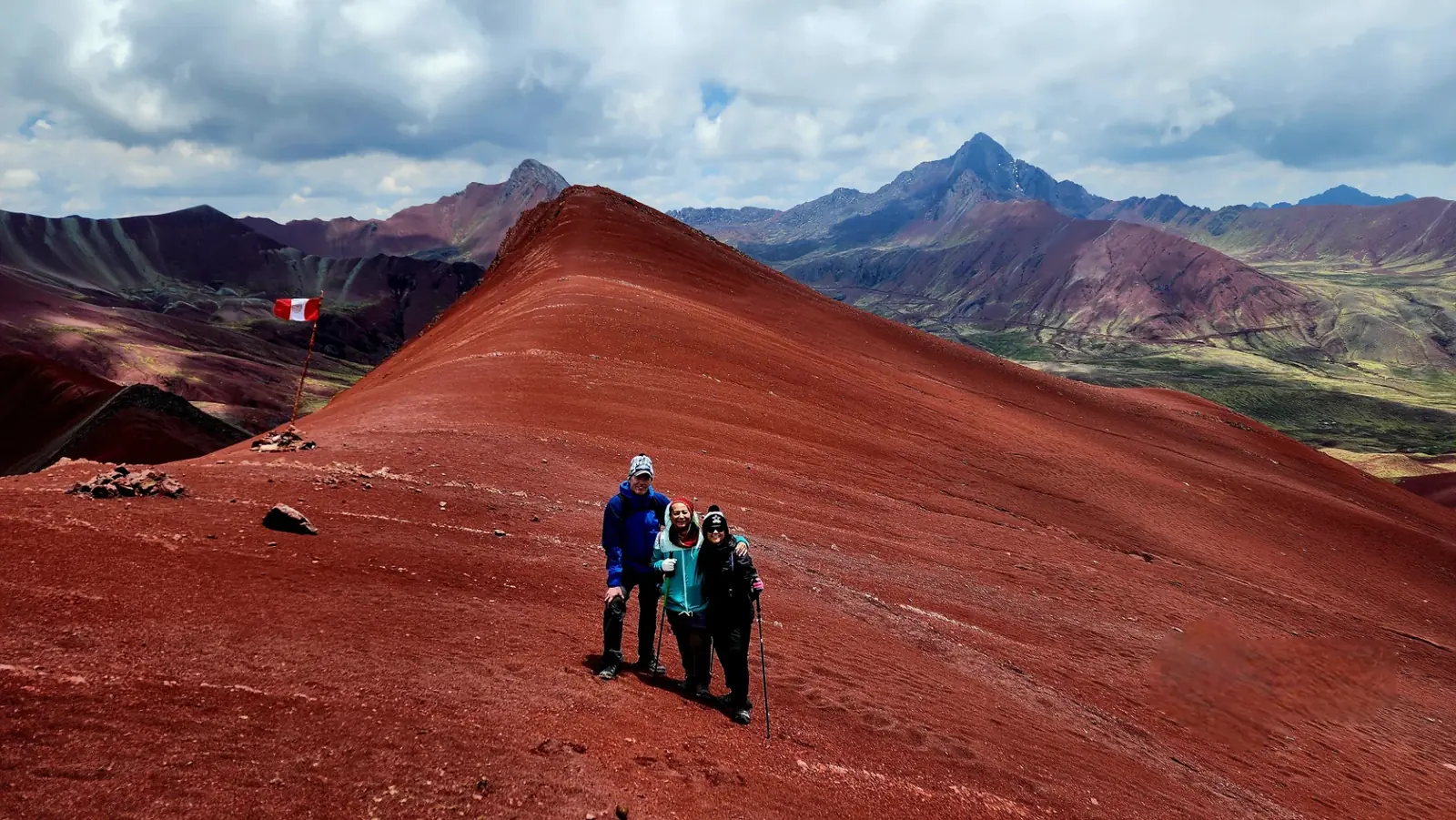
The Red Valley is the same story
The deep red valley on the far side of the ridge is the same sequence, dominated by the iron-rich layers. It is the unmixed version of what Vinicunca shows you in bands — which is exactly why it is worth the extra twenty minutes.
Why nobody had heard of it until 2015
Because it was under ice. For most of recorded history the Vinicunca ridge carried a glacial cap, and what is now a coloured mountain was a white one like every other peak in the Vilcanota range.
The ice retreated over the course of a few decades and exposed the rock beneath. The first tourists arrived around 2015, and the route went from essentially unvisited to one of the most photographed places in Peru inside five years.
It is worth sitting with that for a moment at the viewpoint. The thing you travelled across the world to photograph is visible because of how fast the glaciers here are going.
See the bands from the viewpoint
Our day puts you at the ridge and at the Red Valley, with 5 minutes of walking at each.
From $60 per person
Check availability Ask on WhatsAppWhy the colours change by the hour
Which is a long way of saying: the photographs you have seen are real, and they were taken on a good morning. Our month-by-month guide is about stacking the odds of getting one.
- Moisture. Damp rock is darker and more saturated. The strongest colour is often an hour after overnight rain or light snow melts off.
- Angle of light. Low, raking light picks out the bands; overhead midday sun flattens them.
- Cloud. Thin high cloud diffuses the light and can actually help. Thick cloud removes the mountain entirely.
- Season. The dry months give you reliable light; the wet months give you more saturated rock and far less chance of seeing it.
Questions travelers ask us
Is Rainbow Mountain painted or natural?
Entirely natural. The colours are mineral — iron, copper and sulphur compounds in sedimentary layers — and they run through the rock rather than sitting on it.
How old is Rainbow Mountain?
The sediments were laid down over roughly sixty million years, and the uplift that tilted them has been going on for about fifty million. The exposed coloured surface, though, is new: it emerged from under glacial ice within the last few decades.
Why does it look less colourful than the photos?
Light, moisture and editing, in that order. On a bright midday in the dry season the bands flatten out; after rain, in low light, they are extraordinary. Many published images are also heavily saturated.
Are there other rainbow mountains in Peru?
Yes — Palccoyo is the best known alternative, and the same geology appears across the Vilcanota range. Vinicunca is simply the most concentrated and the most accessible.