When to ride to Rainbow Mountain: month-by-month conditions
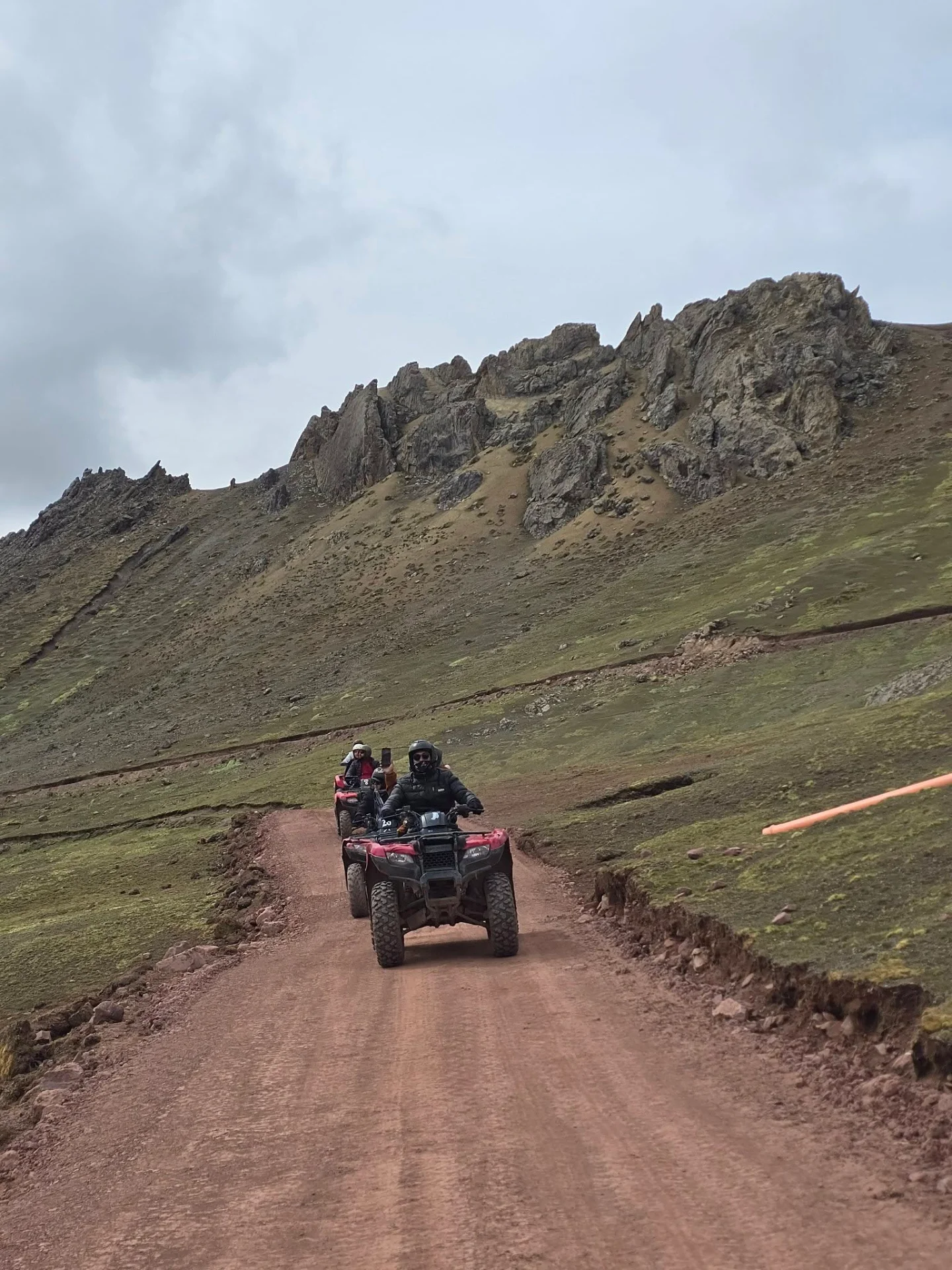
Nearly all Rainbow Mountain weather advice online is written for people walking up. On a quad bike the things that decide whether you have a good day are different: how firm the track is, how hard the wind bites when you are moving, and whether the ridge will be visible at all.
This is our own read, from running the route week in and week out.
Why riding weather is not hiking weather
Three things change when there is an engine under you.
- Mud matters more. A hiker in mud is uncomfortable. A rider in deep mud is slow, filthy and occasionally stuck — so the wet months cost you more on a machine than on foot.
- Wind chill is multiplied. Standing still at −5 °C is manageable. Riding into it adds the equivalent of several degrees. A jacket that is fine for the trek is often not enough here.
- Rain is less of a problem than cloud. You can ride through a shower. You cannot photograph a ridge you cannot see — and the colours flatten dramatically under heavy cloud.
Month by month
| Month | Rain | Dawn temp at altitude | Track surface | For riding |
|---|---|---|---|---|
| Jan | Heavy | 0 to +4 °C | Mud, deep puddles | We would not pick it Wettest stretch. Colours wash out and the track turns slick. |
| Feb | Heaviest | 0 to +4 °C | Mud, washouts | We would not pick it The month we would actively talk you out of. |
| Mar | Heavy | -1 to +4 °C | Soft, improving late | We would not pick it Improves in the last week, but still a gamble. |
| Apr | Occasional | -3 to +2 °C | Firming up, some soft spots | Workable Green landscape, few crowds, real chance of a clear day. |
| May | Rare | -5 to 0 °C | Firm and fast | Best time to ride The sweet spot: dry ground, strong colour, not yet freezing. |
| Jun | Very rare | -7 to -2 °C | Firm, dusty | Best time to ride Clearest skies of the year. Bring a real jacket. |
| Jul | Very rare | -8 to -3 °C | Firm, dusty | Best time to ride Coldest dawns and the most reliable visibility. |
| Aug | Very rare | -6 to -1 °C | Firm, dusty, windy | Best time to ride Excellent, but afternoon wind picks up. Goggles earn their place. |
| Sep | Occasional | -4 to +1 °C | Firm | Best time to ride Our quiet favourite — dry, milder, fewer vehicles. |
| Oct | Occasional | -3 to +2 °C | Mostly firm | Workable Still good. Showers start building late in the month. |
| Nov | Frequent | -2 to +3 °C | Soft in places | Workable A coin toss. Fine early, unreliable by month end. |
| Dec | Heavy | 0 to +4 °C | Mud returns | We would not pick it Rainy season proper. Book another month if you can. |
Figures are typical conditions for the Vinicunca area between roughly 4,300 and 5,030 m. Mountain weather is mountain weather — treat this as a strong tendency, not a forecast.
Found your month? Check that date.
Bookings close 24 hours before departure, and high season fills days ahead.
From $65 per person
Check availability Ask on WhatsAppThe two seasons in practice
Dry season: May to September
This is the season to aim for. Tracks are firm and fast, skies are clear for most of the morning, and the mineral bands are at their strongest. The trade-off is cold: pre-dawn temperatures at altitude sit below freezing through June and July.
If you can pick freely, September is our quiet favourite — still dry, a few degrees milder than July, and noticeably fewer vehicles on the track than August.
Wet season: December to March
We run tours year-round and we will take you in February, but we will also tell you honestly what you are buying: a soft, muddy track, a strong chance the ridge is in cloud, and colours that photograph grey rather than striped.
If your trip is locked to those dates and Rainbow Mountain is a must, go — just arrive with the expectation managed. If it is optional, spend that day in the Sacred Valley instead, where rain costs you far less.
Cold is the real variable, not rain
The complaint we hear most is never about rain. It is about cold — specifically, people who dressed for Cusco at midday rather than for a mountain at dawn with wind on them.
The fix is simple and it is the single highest-value thing in this article:
- A windproof, waterproof outer jacket. Not a hoodie, not a fleece on its own. The wind is the problem.
- Gloves. Your hands sit on the handlebars in moving air for hours.
- A thermal or fleece mid-layer under the jacket.
- A buff or neck gaiter and a thin hat to wear under the helmet.
- Sunglasses and SPF 50+. UV at 5,000 m is brutal even when you feel cold — this catches people out every single week.
You do not need trekking kit
No boots, no poles. Closed shoes with a solid sole are fine. Any packing list telling you to break in hiking boots for this tour was written for the walking version.
What happens if the weather turns
Light rain does not cancel the tour. We only cancel for genuinely dangerous conditions — snowstorms, electrical storms, or a closed road — and when we do, you choose between a free reschedule and a full refund of everything you paid. We make that call early enough to reach you before pickup.
If you cancel yourself, the terms are 100% back at 30 or more days, 50% between 15 and 29 days, and nothing inside 14 days, because by then permits, transport and machines are committed in your name. The full terms are on our refund policy page.
Questions travelers ask us
What is the single best month to ride?
June and July give the most reliable skies, but they are the coldest. If you would rather not start the day below −5 °C, May and September give you nearly the same visibility a few degrees warmer. September is the month we would personally pick.
Is it worth going in the rainy season?
Only if your dates leave no choice. The tour runs, but the track is muddy and the famous stripes often sit under cloud. We would rather you booked a different month than came away disappointed.
How cold does it actually get?
At the viewpoint before the sun is properly up, between about −8 °C and 0 °C depending on the month, and that is before you add wind chill from riding. By late morning in the sun it can feel pleasant. Dress in layers you can shed.
Does rain make the ATV dangerous?
Light rain simply means riding slower, which the guide will set. Heavy, sustained rain or snow is a different matter, and that is when we cancel rather than negotiate — the mountain is not worth it.
Will I see the colours if it is cloudy?
Partly. The bands are mineral, not seasonal, so they are always there — but they need direct light to read properly. Under heavy cloud the mountain looks grey-brown. This is the main reason we leave Cusco at 6:00 AM.